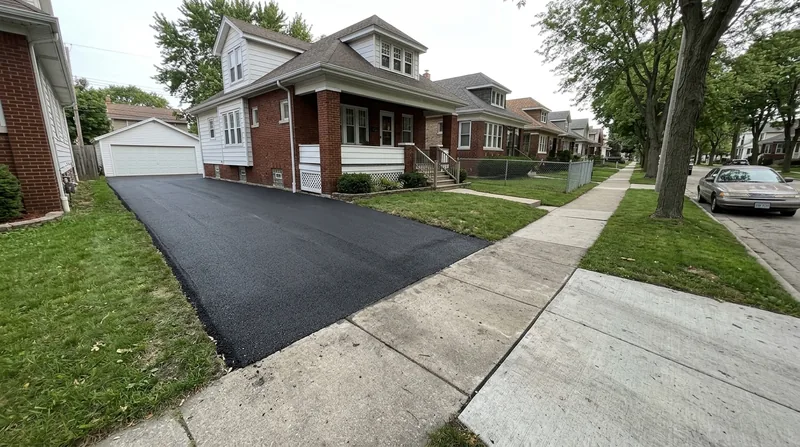




Asphalt Driveway Paving & Installation in Milwaukee demands more than just hot mix spread over dirt. Milwaukee's lake-plain clay swells and shifts through freeze-thaw cycles off Lake Michigan, heaving driveways at the apron and opening alligator cracks where the base has softened. A real aggregate base, proper compaction, and binder and surface courses built to hold through our brutal winters separate a driveway that lasts from one that fails in five years. We build driveways that stand up to the climate we actually have, with tonnage specs and written estimates so you know what you're getting.
Why Asphalt Driveway Paving Matters in Milwaukee's Climate
Milwaukee winters don't just freeze asphalt; they freeze the clay underneath, and that cycle moves the surface. The lake-plain clay that runs under most of the city's bungalows, duplexes, and residential blocks takes water like a sponge. When it freezes, it heaves. When spring thaw comes and the ground softens before drainage clears, the base goes soft and the asphalt settles unevenly. Without a proper aggregate foundation, even a thick top layer will crack and fail within a few seasons. The homes around Lake Michigan in the pre-war core and the post-war subdivisions spreading west toward Waukesha and Brookfield all sit on the same problem soil.
- A real aggregate base absorbs and sheds water instead of holding it like clay does.
- Proper compaction and layering prevent the differential settling that cracks asphalt in spring.
- Binder and surface courses flexed for freeze-thaw cycles hold longer than a single thick layer.
- Written tonnage specifications guarantee the depth and density you paid for, not a guess.
- Seasonal paving (mid-April through mid-November) ensures mix temperatures and curing conditions that hold in Wisconsin's climate.
The difference shows up in year three, when neighbors' driveways are cracking and yours is still solid.
Key info: Milwaukee's building code and permit process for driveway aprons, curb cuts, and impervious surface limits vary by municipality. Your village or city sets the rules. We help you navigate the local permitting process, but you should verify requirements with your building department before we break ground, especially if the work touches the sidewalk, curb, or public right-of-way.
For detailed information on Milwaukee's municipal permitting, visit the City of Milwaukee Department of City Development website or contact your local building inspector.
How We Build a Driveway That Holds in Milwaukee
The work starts below the surface. We remove failed pavement and grade the subbase to shed water away from the structure. A properly compacted aggregate base goes down next, proof-rolled to verify density. Then the binder course (thicker, coarser mix for flexibility) and the surface course (finer, harder wearing layer) are laid in sequence and rolled to spec. Each step is measured, not guessed. The whole job takes planning: we schedule around the paving season, coordinate with your municipality if permits are required, and call Wisconsin 811 for utility locates before any excavation begins.
- We measure the driveway, verify site access and drainage, and confirm local permit and HOA requirements with you.
- We call Wisconsin 811 for a utility locate if the job involves excavation, grading, or full-depth work.
- We remove failed asphalt and grade the subbase, compacting and sloping for drainage.
- We lay and compact the aggregate base in lifts, proof-rolling to verify density and stability.
- We apply the binder course (the flexible lower layer) and roll it to specification.
- We apply the surface course (the wearing layer you drive on) and finish-roll for a smooth, durable top.
- You stay off the driveway for 24 to 48 hours while the mix cools and sets, depending on weather.
That sequence is why asphalt resurfacing often makes more sense than a full replacement: if the base is still sound, we skip the excavation and grading, lay a new binder and surface, and save you thousands.
Local example: A pre-war bungalow in Milwaukee's South Side with a tight side drive and clay subgrade needed a new driveway. The old apron had heaved at the sidewalk, and alligator cracking showed the base was gone. We excavated to grade, laid 6 inches of compacted aggregate base, then 2 inches of binder and 1.5 inches of surface course. The driveway now sheds water and has handled three winters without a crack. The homeowner got a written tonnage spec, and we pulled the required permit with the city.
Methods and Approaches for Asphalt Driveway Installation
| Approach | Description | Best For |
|---|---|---|
| Full-Depth Replacement | Excavate failed asphalt and subbase, grade and compact new aggregate foundation, lay binder and surface courses to spec. | Driveways with failed base (alligator cracking, severe heaving, soft spots), or when extending the driveway or changing drainage. |
| Asphalt Overlay (Resurfacing) | Mill the top layer if needed, lay new binder and surface courses over a sound existing base. | Driveways with a solid base but worn or cracked surface, or when budget and base condition allow skipping full excavation. |
| Full-Depth Reclamation (Milling and Reuse) | Mill the existing asphalt in place, blend it with new binder, recompact, and top with a fresh surface course. | Large parking lots and private roads where excavation is impractical and the existing base is structurally sound. |
| Recycled Asphalt Millings Driveway | Lay compacted recycled asphalt (RAP) as a wearing surface over a prepared base, sealed or unsealed. | Rural driveways, HOA roads, and budget-conscious homeowners who accept a gravel-like appearance and regular raking. |
Asphalt Driveway Paving & Installation Cost in Milwaukee: What to Expect
Asphalt driveway paving starts at $6 per square foot for a straightforward overlay on a sound base in good access. That figure moves up with the scope of work. A full-depth replacement with excavation, grading, and proper base preparation runs higher because you're paying for labor, equipment, and material below the surface. The age and condition of the existing drive, the slope and drainage situation, soil type, and proximity to structures or utilities all affect the final cost. We provide a written estimate with tonnage specifications so you know exactly what materials and depth you are paying for, not a vague per-square-foot guess.
The best way to understand cost is to get two or three estimates from contractors who will measure the site, inspect the base, and give you a written breakdown. Estimates are free and typically come back within 24 hours. Call us at (414) 982-3074 for yours, or visit our pricing page for more detail on what moves the needle on cost.
One common mistake: choosing a contractor based on price alone. The cheapest bid often cuts corners on base preparation or thickness. In Milwaukee's climate, a thin layer over poor base will fail in three to five years, and then you are paying twice. A properly built driveway costs more upfront but lasts two to three times longer and costs less over its life.
Asphalt Driveway Paving & Installation Near Me: What Milwaukee Homeowners Should Know
When you are looking for a contractor to pave or repave your driveway, start with the basics. Verify that any contractor you consider is fully insured (ask for a certificate of insurance). Licensing and permitting requirements for asphalt paving are set by your municipality, not the state, so contact your local building department to understand what credentials and permits apply to your job. Ask for written estimates with tonnage and thickness specified, not just a price per square foot. Check references from recent jobs in your neighborhood if you can. If the work touches the sidewalk, curb, or public right-of-way, or if it changes drainage, a permit is likely required in your city. If you live in an HOA community, verify that the material and scope comply with architectural standards before you sign anything.
Be wary of the itinerant pitch: an unsolicited door-to-door offer, no written contract, a price that sounds too good, out-of-state plates, and a request for a large cash deposit upfront are the classic markers of a paving scam. A local contractor with a local address, local insurance, and a written estimate that you can verify is the safer choice. We have been in business since 2014 and work in Milwaukee and the surrounding communities. You can verify our insurance, call us directly at (414) 982-3074, and get a free, no-obligation estimate. Contact us to schedule yours.
Asphalt Driveway Paving & Installation in Milwaukee: Pricing Guide
| Service | Price | Details |
|---|---|---|
| Asphalt Overlay (Resurfacing) | Starting at $6/sq ft | Binder and surface courses over sound base; cost increases with milling, site access complexity, or drainage work |
| Full-Depth Replacement | Starting at $10/sq ft | Excavation, grading, aggregate base, binder and surface; higher cost reflects labor and material below surface and base prep |
| Recycled Asphalt Millings Driveway | Starting at $3/sq ft | Compacted RAP over prepared base; lower cost assumes no paving plant mix; regular raking and maintenance required |
| Milling and Full-Depth Reclamation | On estimate | Large parking lots and private roads; scope, equipment access, and existing material quality require on-site assessment |
| Estimate and Site Visit | Free | Written estimate with tonnage and thickness specifications; response within 24 hours at (414) 982-3074, no obligation to book |
Indicative pricing, the exact cost depends on square footage, finish, and site access. Free personalized estimate within 24h at (414) 982-3074.


