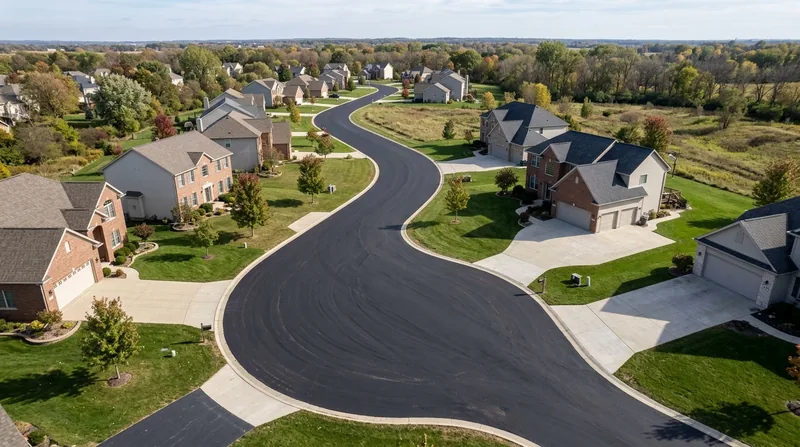




Private Road & HOA Paving in Milwaukee means rebuilding the asphalt surfaces that bind together the subdivisions and master-planned communities across Greater Milwaukee. The clay subgrade under these roads, especially in Waukesha and Washington county developments, moves with every freeze-thaw cycle and every wet spring. Decades of that movement crack and heave the surface, and heavy HOA traffic loads accelerate the failure. We rebuild the base first, then pave in binder and surface lifts sized for Wisconsin winters and the traffic those roads actually carry. The result is a road that holds for years, not one that fails in the next season.
Why HOA and Private Road Paving Fails in Milwaukee's Clay Landscape
Milwaukee's post-war subdivisions and the newer master-planned communities spreading into Waukesha, Washington and Ozaukee counties all sit on the same heavy lake-plain clay that dominates the region. That clay swells when it absorbs water and shrinks as it dries. Every winter, freeze-thaw cycles heave the roadbed. Every spring, meltwater softens the base layer and allows the surface to sink. Plowing scars the edges. Without a proper aggregate base and compaction, asphalt laid directly on clay fails in alligator cracking and surface breakup within five to seven years, and the repair bill grows every season.
- Clay movement opens alligator cracks across the surface, a sign that the base has failed and patching will not hold.
- Frost heave at the apron and the road edges, especially near curbs and drainage, lifts the surface and breaks it apart.
- Water trapped in a soft base layer accelerates failure and makes the road unsafe for heavy vehicles.
- Plowing damage and edge breakup compound each winter, turning a repairable surface into a replacement job.
The fix is a rebuilt base and a properly compacted asphalt lift sized for the traffic and the climate. That investment holds for fifteen to twenty years or more.
Key info: HOA roads in subdivisions like those in Brookfield, Menomonee Falls and New Berlin carry decades of clay movement below the surface. We excavate failed base material, recompact the subgrade, install a new stone base, and pave in two lifts: a binder course and a surface course. That method holds under Wisconsin winters and typical HOA traffic loads.
For more on how base failure develops and what it costs to repair, see our guide to asphalt resurfacing and overlay decisions.
How We Rebuild HOA Roads: The Process and the Milwaukee Approach
Private road and HOA paving starts with a site visit and a measurement. We assess the existing surface, probe the base, and determine whether the road can be resurfaced over a stable base or whether it needs full-depth reconstruction. Once we know the scope, we prepare a written estimate that specifies the tonnage of asphalt, the thickness of each lift, and the timetable. We schedule the work during the paving season, mid-April through mid-November, when the asphalt plants are running and the weather is stable enough for proper compaction.
- We measure the road and take test cores or probe pits to evaluate the base layer and the subgrade condition.
- We mill or remove the failed surface and excavate any base material that has softened or displaced.
- We recompact the subgrade, install a new aggregate base course, and proof-roll to verify density and support.
- We pave the binder course, then the surface course, in two lifts compacted to specification.
- We allow the new asphalt to cure for six to twelve months before any seal coating is applied.
That sequence ensures that the road will not settle or crack prematurely and that the base will support the traffic for years to come.
Example: A private road serving twelve homes in Waukesha had alligator cracking across forty percent of its surface and soft spots in the wheel paths. We removed the failed asphalt and two inches of base, recompacted the clay subgrade, installed four inches of new stone base, and paved a two-inch binder and two-inch surface. The road is now rated for the traffic it carries and will hold for eighteen to twenty years.
See our full guide to asphalt milling and removal for more on the preparation work that supports a long-lasting paving job.
Methods and Materials for Private Road Paving in Milwaukee
| Approach | Description | Best for |
|---|---|---|
| Full-depth replacement | Remove failed asphalt and base, recompact subgrade, install new stone base, pave two lifts (binder and surface). | Roads with alligator cracking, soft base, or settlement; clay subgrades that need stabilization. |
| Mill and overlay | Mill off the top two inches of asphalt, recompact the remaining base, and pave a new two-inch surface course. | Roads with surface cracking but a solid base; cost-effective refresh when the base is not failed. |
| Recycled asphalt base | Reuse milled asphalt as base material, compacted and bound with a new surface course or a tack coat. | Budget-conscious HOA projects where the milled material is clean and free of contamination. |
| Binder and surface paving | Two-lift asphalt: binder course (wearing course) and surface course, each compacted and cured before the next. | All new construction and full-depth replacement; standard practice for durability in Wisconsin winters. |
Private Road & HOA Paving Cost in Milwaukee: What to Expect
HOA and private road paving costs depend on the scope of work, the condition of the existing base, the length and width of the road, and the thickness of the asphalt lifts required. A typical private road project serving a small subdivision starts at $15,000 and can reach $50,000 or more depending on the road length, the base work required, and whether drainage or utility work is involved. A longer road or one that requires full-depth reconstruction will cost more than a mill-and-overlay on a stable base. The best way to know the actual cost for your road is to have us measure it, assess the base condition, and prepare a written estimate that specifies the tonnage and the thickness of each lift.
Several factors move the cost up or down. A road with a failed base requires excavation and new stone, which adds labor and material. A road with soft spots or settlement may need subgrade stabilization before paving. Winter damage from plowing or frost heave may require edge repair or apron work. Drainage issues, utility crossings, or culvert work add scope and cost. A longer road or one that serves more homes costs more in total asphalt tonnage, but the per-ton cost may be lower because we are spreading the setup and mobilization across more material.
We always provide a written estimate before we start, with the tonnage and the lift thicknesses spelled out. That way you know exactly what you are paying for and why. For a detailed breakdown of pricing across all our services, visit our full pricing page.
Private Road & HOA Paving Near Me: What Milwaukee Homeowners and Property Managers Should Know
Before you hire a paving contractor for your HOA road or private drive, verify a few things. First, confirm that the contractor is fully insured and willing to provide a certificate of insurance. In Wisconsin, municipal licensing and permitting requirements for asphalt paving vary by city and village, so contact your local building department to learn what permits and contractor qualifications your jurisdiction requires. Many HOAs have architectural standards or design guidelines that govern driveway and road materials, so check your HOA rules before you commit to a contractor or a design. If your road project involves a curb cut, an apron, a culvert, or changes to drainage or stormwater flow, a permit is likely required. Wisconsin law requires a utility locate (Wisconsin 811) before any excavation, and that includes base work, grading, and drainage. Get that locate marked before we start digging.
- Ask the contractor for references from other HOA or private road projects in your area, and call at least two to verify the work and the timeline.
- Request a written estimate that specifies the asphalt tonnage, the thickness of each lift in inches, and the timeline for completion.
- Verify that the contractor will obtain the Wisconsin 811 utility locate before any excavation or base work begins.
- Confirm that your HOA board has approved the project scope and budget, and that any required municipal permits have been applied for before paving begins.
- Understand that new asphalt must cure for six to twelve months before seal coating is applied, and plan your maintenance schedule accordingly.
Honest guidance is what sets a trustworthy paving contractor apart. If your road can be resurfaced instead of fully replaced, we will tell you that. If the base is stable and a mill-and-overlay will hold for another ten to fifteen years, that is what we will recommend. If the base has failed and a full-depth replacement is the only fix, we will explain why and what it costs. For a free estimate and to discuss your road's specific needs, contact us at (414) 982-3074. We respond within 24 hours and will help you navigate any local permitting or HOA requirements.
Private Road & HOA Paving in Milwaukee: Pricing Guide
| Service | Price | Details |
|---|---|---|
| Small private road (under 200 linear feet) | Starting at $15,000 | Mill and overlay or full-depth replacement depending on base condition; includes measurement, estimate, and compaction |
| Medium HOA road (200 to 500 linear feet) | Starting at $28,000 | Full-depth reconstruction with new stone base, binder and surface courses; cost varies with base excavation depth and width |
| Large subdivision or private road (500+ linear feet) | Starting at $45,000 | Multi-phase paving with base stabilization, drainage work, and two-lift asphalt; includes site assessment and proof-rolling |
| Drainage, culvert, or utility work | On estimate | Additional scope beyond asphalt requires on-site inspection to determine labor, material, and coordination with municipal requirements |
| Estimate and site visit | Free | Measurement, core sampling, and written estimate with tonnage and lift thickness specified; response within 24 hours |
Indicative pricing, the exact cost depends on square footage, finish, and site access. Free personalized estimate within 24h at (414) 982-3074.


